Ceuta Border Tightened
Spanish authorities installed a 500-metre floating barrier off Ceuta on Saturday, tightening the enclave’s sea border with Morocco after a mass crossing left at least 67 people dead.
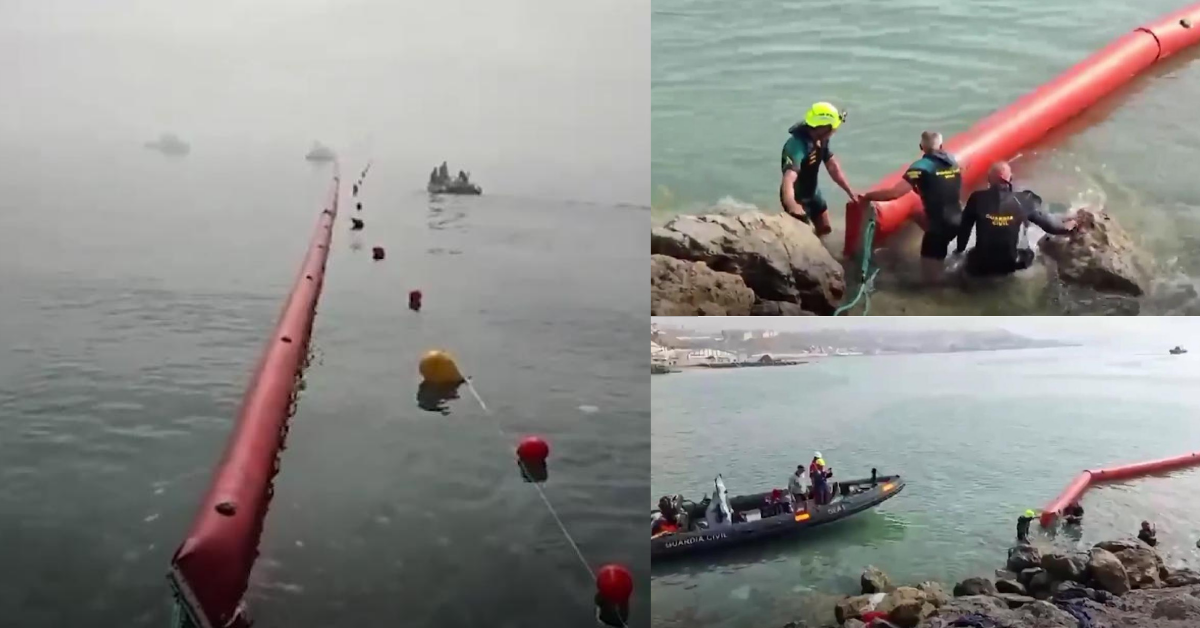
Footage shows Civil Guard officers working from patrol boats and the Tarajal breakwater, fastening the inflatable barrier to the rocks. A second line of anchored buoys supplied by the Spanish Navy stretches across the water.

“The device consists of a 500-metre pneumatic barrier, reinforced with a line of buoys from the Navy, which will enable improved control and surveillance of the area,” the Civil Guard said on X.
The barrier rises between 30 and 70 centimetres above the water and extends one metre below the surface. A channel between the two lines allows Civil Guard boats to patrol and protect the structure.
Deadly Crossing Crisis
Spain’s government estimated that around 50,000 people entered Ceuta from Morocco on Thursday and Friday, while local authorities put the figure as high as 60,000. Around 48,300 had returned to Morocco by Friday evening, and further departures continued on Saturday.
The death toll rose to at least 67 as search teams continued operating near the border. Some of those killed drowned while trying to reach Ceuta by sea, while others died in a crush at the breakwater.

Prime Minister Pedro Sanchez visited Ceuta on Friday and described the crossings as an ‘attack’ and a ‘violation of Spain’s territorial integrity’. He thanked Morocco for its cooperation and said the government would use all available resources to secure the enclave.
Europe Boosts Controls
The crisis also triggered tighter controls elsewhere in Europe. Italy reintroduced checks for one month on passengers arriving from Spain by air and sea, focusing particularly on non-EU citizens, while France strengthened controls along its land border with Spain.
EU interior ministers are due to hold emergency talks by video conference August 4, to coordinate the bloc’s response.
Spain’s Civil Guard, via Viory.Video
Related Post:
Economist warns migrant exodus could cripple informal markets
Share this content: