People with disabilities are not marginal to society but central to it – and the injustices they face reveal the failures of a world that treats human dignity as subordinate to profit.
Article by Vijay, Tricontinental: Institute for Social Research.
Dear friends,
Greetings from the desk of Tricontinental: Institute for Social Research.
A few weeks ago, while I was in Bandung, Indonesia, a man who uses a wheelchair told me that the total number of people living with disabilities has been calculated by the United Nations’ World Health Organization (WHO) to be 1.3 billion. People with disabilities are neither a minority nor an exception. They are a vast constellation of human experience – one-sixth of humanity. And yet, they are too often spoken of as if they exist at the margins of history. In truth, they stand at its centre.
Disability is not merely a biological condition; it is shaped by the interaction between impairment and the world around it: by the broken road that prevents a wheelchair from moving forward, by the clinic or hospital that charges fees before offering care, by the classroom that excludes the child who learns differently, by the war that shatters bodies, and by the economy that abandons those it deems ‘unproductive’. Disability is not simply a restriction resulting from an impairment, but a collision between impairment, social barriers, and injustice.

The landmark 2022 WHO report, Global Report on Health Equity for Persons with Disabilities, is careful in its language. The report argues that what individuals with disabilities face are not only ‘inequalities’ but ‘health inequities’ that are avoidable and rooted in injustice. To recognise these inequities as avoidable is to recognise them as political and hence as a result of the choices made within the capitalist system. This 2022 report builds on an earlier 2011 report on disability by the WHO and the World Bank, which called for stronger data collection and more inclusive support and access so that people with disabilities can fully participate in society.

One of the most striking facts in the 2022 WHO report is that 80% of people with disabilities live in the Global South. Terrible working conditions, environmental degradation, polluted food and water systems, appalling healthcare systems, and warfare create and exacerbate disabilities. As of 2019, at least one in five people in conflict zones lived with mental health conditions; in the ruins of war, disability multiplies, not only through injury but through trauma, hunger, and displacement. Gaza is now the region with the highest concentration of child amputees. The Global South does not merely contain disability; disability is produced there by systems that were not of its own making.
The vicious cycle between disability and poverty is highlighted in the 2022 WHO report, which notes that ‘persons with disabilities are less likely to access education and employment’ and therefore ‘more likely than those without disabilities to live in poverty’. They are more likely to be denied care, experience higher rates of disease and exclusion, and die earlier. This is not fate but design. The WHO report also shows that these inequities appear across three health outcomes: premature mortality, increased morbidity, and greater barriers to daily functioning and participation in society. During COVID-19, for instance, these long-standing inequities became even more visible; studies in specific contexts found sharply higher mortality rates among people with intellectual or learning disabilities. These are not merely medical facts but indictments against a system that is symbolically committed to people with disabilities – through programmes like the 2006 UN Convention on the Rights of Persons with Disabilities – yet unable, or unwilling, to act on those commitments.
The 2022 WHO report notes plainly that ‘A wide range of differences in health outcomes exist between persons with disabilities and those without disabilities. Some of these differences are inequalities that can be explained by the underlying health conditions or impairments; however, others are associated with factors that are unjust or unfair’. In other words, the WHO acknowledges that many of these poor health outcomes are not inevitable but are produced by a system built unjustly and unfairly.
This architecture of exclusion includes:
- Health systems that require payment at the point of care.
- Public communications that are inaccessible to people who are blind, have low vision, are deaf, or are hard of hearing.
- Inaccessible transportation systems that prevent people from getting to hospitals.
- Gendered violence that disproportionately targets women with disabilities.
- Employment systems that discard people who are seen as ‘unproductive’.
These characteristics of society and the state have been normalised in our capitalist world order. It has become common sense to believe that infrastructure designed for accessibility is expensive, but this is the wrong way of understanding the future. In 2025, Asian Development Bank President Masato Kanda argued that investment in primary healthcare is not only socially necessary but economically beneficial, noting that every dollar invested can yield up to $10 in economic growth. When primary healthcare, community health workers, and universal health coverage are built to include people with disabilities from the outset, they improve health outcomes for everyone and strengthen societal resilience.
The 2006 UN Convention marked a shift in policy and thought from seeing people with disabilities as objects of care to recognising them as subjects of rights and citizens of the world. To speak of disability in this theoretical frame is to speak of society itself. A society that includes people with disabilities cannot merely make technical adjustments; it must be transformed. It requires universal public healthcare systems that reach all people, public infrastructure built for accessibility from the start, education systems that embrace difference, and political systems that emphasise participation. In 2022, the WHO correctly noted that addressing disability inequities benefits everyone because it dismantles barriers that constrain all human life.
Drawing on the demands found in WHO reports and disability rights movements across different countries, we propose an eight-point plan for dignity and disability justice:
- Participation and leadership. People with disabilities must be central in decision-making; policy must follow the ethos of ‘nothing about us without us’.
- Accessible public information. All public communications must be available in multiple formats, including Braille, sign language, and accessible digital formats.
- Data, accountability, and enforcement. Governments must collect disability-disaggregated data and meaningfully enforce anti-discrimination laws.
- Universal accessibility by design. All infrastructure – transport, housing, and digital systems – must be built on the principle of accessibility from the outset.
- Universal healthcare. Health systems must guarantee access to prevention, treatment, rehabilitation, and assistive technologies without financial barriers.
- Inclusive education systems. All children, including children with disabilities, must be guaranteed access to quality education within the mainstream public system.
- Community-based care systems. Locally embedded care and support networks must be built, hiring and training care workers from the communities in which they work.
- Economic justice and social protection. States must ensure income support, employment rights, and labour protections that recognise the additional costs of disability.
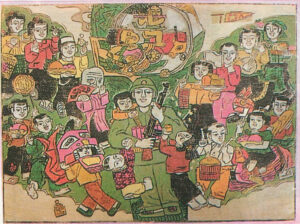
A few years ago, while walking in rural Vietnam with elders who had taken part in the resistance, I heard about the couriers who carried messages between villages during the struggle. They told me that the movement recruited a variety of people for this job, but it was not uncommon to rely upon Anh Điếc (Brother Deaf) and Chị Mù (Sister Blind) to carry messages. It occurred to me that in our national liberation movements, we have done a terrible job of documenting the role of comrades with disabilities in our struggles. This is not the case in Vietnam, where the Thương binh, a term often translated as ‘war invalids’ but more literally referring to wounded soldiers, are repaid with chính sách đền ơn đáp nghĩa (the ‘policy of gratitude and reciprocity’) and with a Day of War Invalids and Martyrs on 27 July each year.
In 1981, six years after the Vietnamese defeated the United States, the remarkable poet Trần Tiến was walking on Tien Hai beach near the Red River Delta when he saw the round marks left by a crutch in the sand. He later learned that they belonged to a wounded veteran with a leg injury who crossed the beach on his way to the local school to teach children. From that encounter, Trần Tiến wrote ‘Round Footprints on the Sand’ (Vết chân tròn trên cát), which also became an enormously popular song. Here are a few lines from that poem:
Round footprints still wander along the white sandy path of my hometown.
The wounded soldier still goes to the village school.
Still holding the guitar, still teaching the children songs of their homeland.
The song holds the distant mountains of his homeland.
The song holds endless rice fields and folk melodies.
The song is about soldiers who fell in silence.
For today, those little rosy feet, joyful around the round footprints…
Written by Vijay, via The Tricontinental Institute for Social Research
Related Post:
The Democracy of the Strongest Is Always the Best: The Eighteenth Newsletter (2026)
A Dialogue Across Civilisations, for Now: The Seventeenth Newsletter (2026)
Share this content: