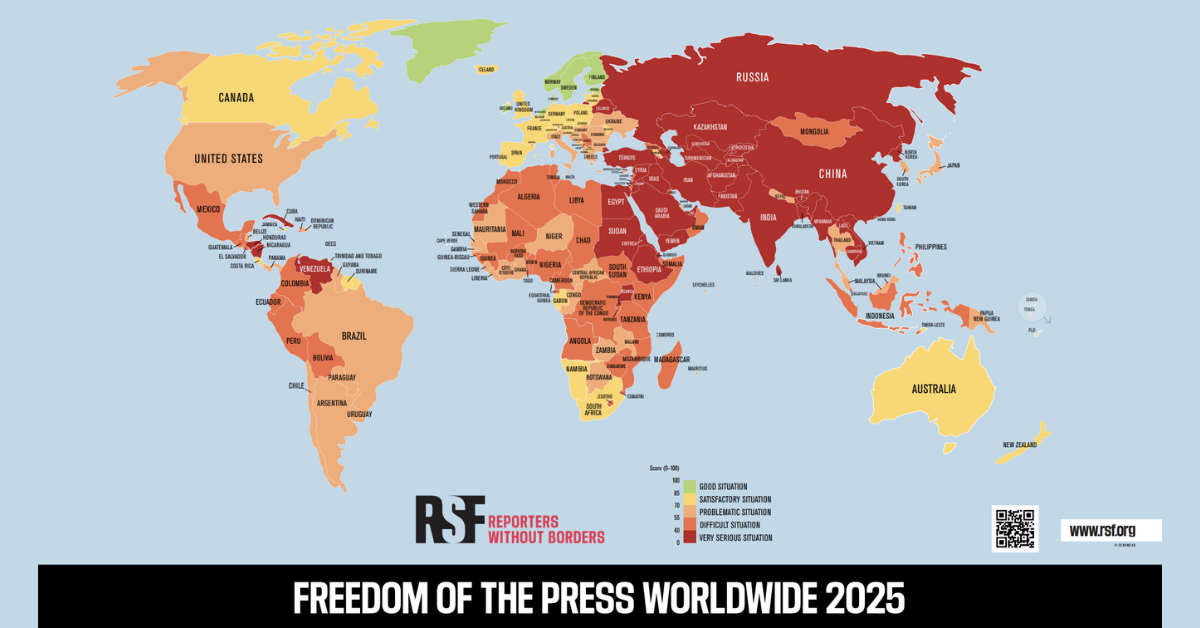
Although physical attacks against journalists are the most visible violations of press freedom, the wide cracks in the media’s economic sustainability are shaking the foundations of journalism. The economic indicator on the RSF World Press Freedom Index now stands at an unprecedented, critical low as its decline continued in 2025. As a result, the global state of press freedom is now classified as a “difficult” situation for the first time in the history of the Index.
At a time when press freedom is experiencing a worrying decline in many parts of the world, a major — yet often underestimated — factor is seriously weakening the media: economic pressure. Much of this is due to ownership concentration, pressure from advertisers and financial backers, and public aid that is restricted, absent or allocated in an opaque manner. The data measured by the RSF Index’s economic indicator clearly indicates that today’s news media are caught between preserving their editorial independence and ensuring their economic survival.
“Guaranteeing freedom, independence and plurality in today’s media landscape requires stable and transparent financial conditions. Without economic independence, there can be no free press. When news media are financially strained, they are drawn into a race to attract audiences at the expense of quality reporting, and can fall prey to the oligarchs and public authorities who seek to exploit them. When journalists are impoverished, they no longer have the means to resist the enemies of the press — those who champion disinformation and propaganda. The media economy must urgently be restored to a state that is conducive to journalism and ensures the production of reliable information, which is inherently costly. Solutions exist and must be deployed on a large scale. The media’s financial independence is a necessary condition for ensuring free, trustworthy information that serves the public interest.”
Anne Bocandé, RSF Editorial Director
Title : In 2025, the conditions for journalism are poor in half the world’s countries.
Of the five main indicators that determine the World Press Freedom Index, the indicator measuring the financial conditions of journalism and economic pressure on the industry dragged down the world’s overall score in 2025.
The economic indicator in the 2025 RSF World Press Freedom Index is at its lowest point in history, and the global situation is now considered “difficult.”
The ongoing wave of media shutdowns
- According to data collected by RSF for the 2025 World Press Freedom Index, in 160 out of the 180 countries assessed (88.9 per cent), media outlets achieve financial stability “with difficulty” — or “not at all.”
- Worse, news outlets are shutting down due to economic hardship in nearly a third of countries globally. This is the case in Tunisia (129th, down 11 places), Argentina (87th, down 21 places) and Greece (89th). Even relatively well-ranked countries such as South Africa (27th) and New Zealand (16th) are not immune to such challenges.
- Media closures have led to the exile of journalists in 34 countries. This is especially true in Nicaragua (172nd, down 9 places), Belarus (166th), Iran (176th) and Afghanistan (175th), where economic difficulties compound the effects of political pressure.
The United States: leader of the economic depression
In the United States (57th, down 2 places), where the economic indicator has dropped by more than 14 points in two years, vast regions are turning into news deserts. Local journalism is bearing the brunt of the economic downturn: over 60 per cent of journalists and media experts surveyed by RSF in Arizona, Florida, Nevada and Pennsylvania agree that it is “difficult to earn a living wage as a journalist,” and 75 per cent believe that “the average media outlet struggles for economic viability.” The country’s 28-place drop in the social indicator reveals that the press operates in an increasingly hostile environment.
President Donald Trump’s second term has already intensified this trend as false economic pretexts are used to bring the press into line. This led to the abrupt end to funding for the U.S. Agency for Global Media (USAGM), which affected several newsrooms — including Voice of America and Radio Free Europe/Radio Liberty — and, as a result, over 400 million citizens worldwide were suddenly deprived of access to reliable information. Similarly, the freeze on funding for the US Agency for International Development (USAID) halted US international aid, throwing hundreds of media outlets into a critical state of economic instability and forcing some to shut down — particularly in Ukraine (62nd).
Media concentration and the dominance of online platforms
These serious funding cuts are an additional blow to a media economy already weakened by the dominance that tech giants such as Google, Apple, Facebook, Amazon and Microsoft have over the dissemination of information. These largely unregulated platforms are absorbing an ever-growing share of advertising revenues that would usually support journalism. Total spending on advertising through social media reached 247.3 billion USD in
2024, a 14 per cent increase compared to 2023. These online platforms further hamper the information space by contributing to the spread of manipulated and misleading content, amplifying disinformation.
In addition to the loss of advertising revenue, which has severely disrupted and constrained the media economy, media ownership concentration is another key factor in the deterioration of the Index’s economic indicator and poses a serious threat to media plurality. Data from the Index shows that media ownership is highly concentrated in 46 countries and, in some cases, entirely controlled by the state.
This is evident in Russia (171st, down 9 places), where the press is dominated by the state or Kremlin-linked oligarchs, and in Hungary (68th), where the government stifles outlets critical of its policies through the unequal distribution of state advertising. It is also apparent in countries where “foreign influence” laws are used to repress independent journalism, such as Georgia (114th, down 11). In Tunisia (129th, down 11), Peru (130th) and Hong Kong (140th), funding is now directed toward pro-government media.
Even in highly ranked countries like Australia (29th), Canada (21st) and Finland (5th), this hyper-concentration is cause for concern. In France (25th, down 4 places), eight wealthy individuals own about 20 press titles, accounting for 81 per cent of the circulation of national daily newspapers and 95 per cent of general-interest national weekly magazines. This growing concentration restricts editorial diversity, increases the risk of self-censorship and raises serious concerns about newsrooms’ independence from the economic and political interests of their shareholders.
The Index’s survey shows that editorial interference is indeed compounding the problem. In over half of the countries and territories evaluated by the Index (92), a majority of respondents reported that media owners “always” or “often” limited their outlet’s editorial independence imposed by media owners. In Lebanon (132nd), India (151st), Armenia (36th) and Bulgaria (70th, down 11 places), many media outlets owe their survival to conditional financing from individuals close to the political or business worlds. The majority of respondents in 21 countries, including Rwanda (146th), the United Arab Emirates (164th) and Vietnam (173rd), said media owners “always” interfered editorially.
20250305_Evolution_par_indicateurs_EN@2x.png
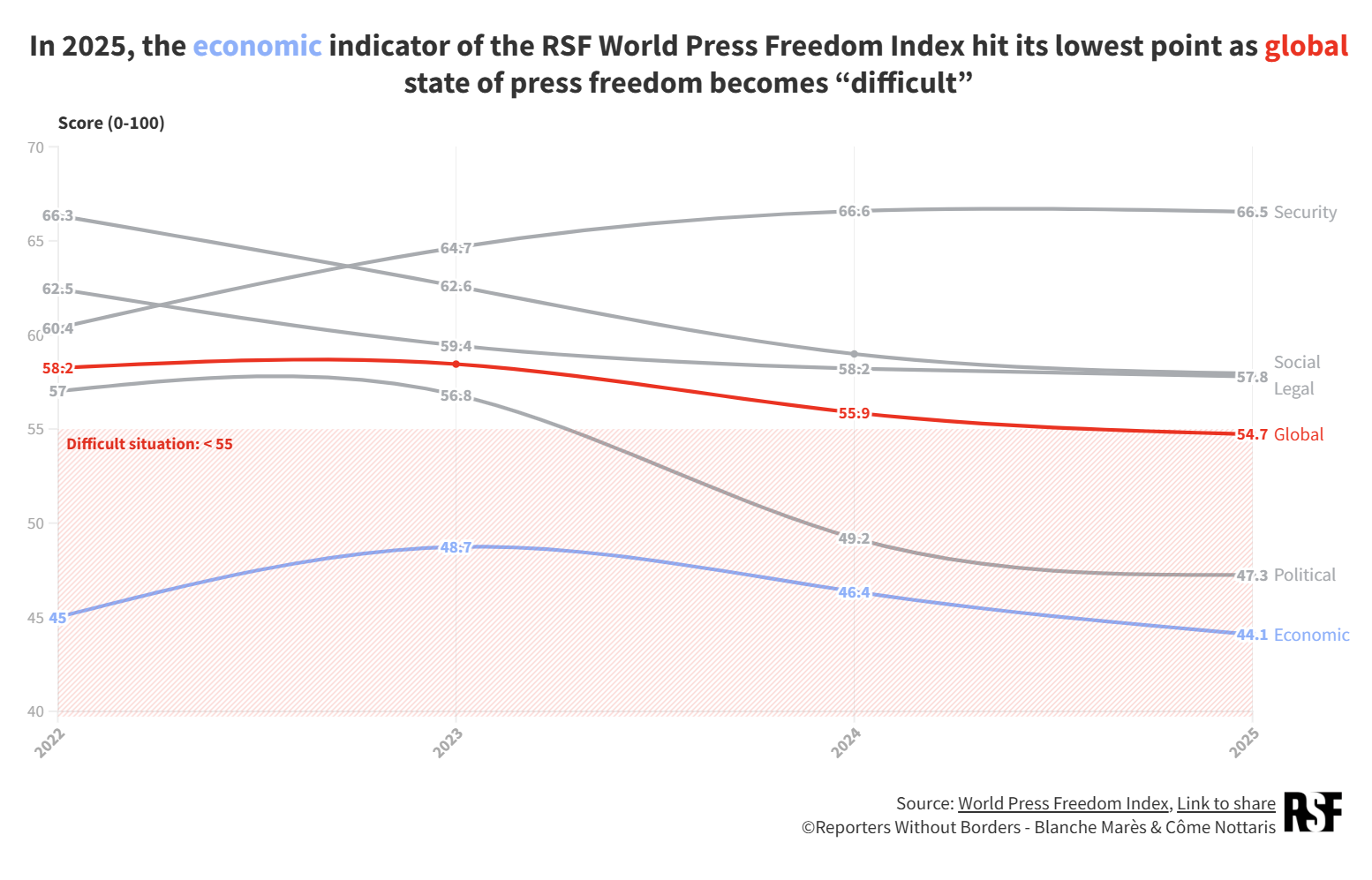
Global state of press freedom is “difficult,”, a historical first
For over ten years, the Index’s results have warned of a worldwide decline in press freedom. In 2025, a new low point emerged: the average score of all assessed countries fell below 55 points, falling into the category of a “difficult” situation. For the first time in the history of the Index, the conditions for practising journalism are poor in half of the world’s countries and satisfactory in fewer than one in four.
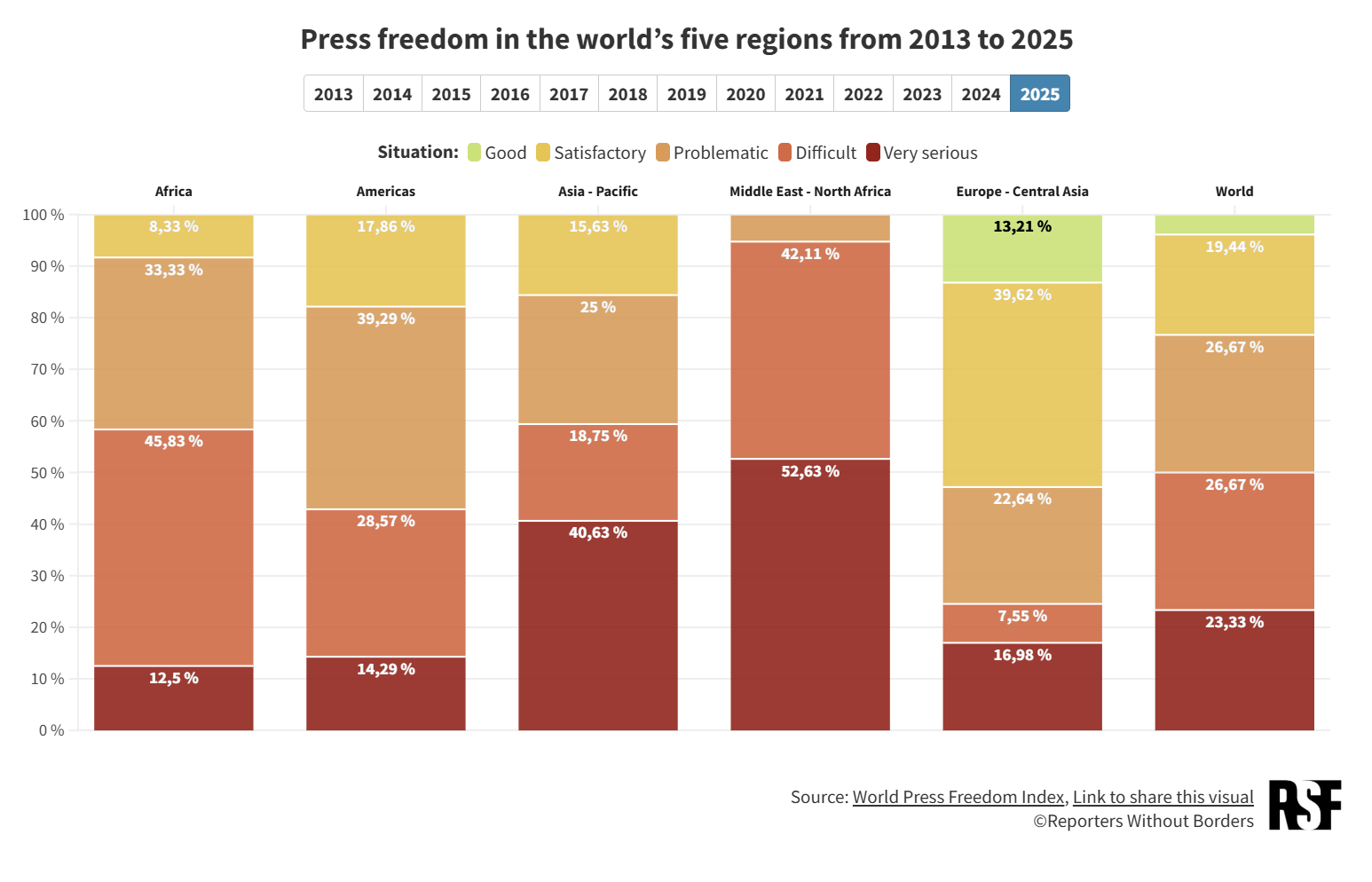
2025_INDEX_Régions_EN.png
Title: Press freedom in the world’s five regions from 2013 to 2025
Six new countries in the “very serious” category
In 42 countries — harbouring over half of the world’s population (56.7 per cent) — the situation is classified as “very serious.” In these zones, press freedom is entirely absent and practising journalism is particularly dangerous. This is the case in Palestine, where the Israeli army has been annihilating journalism for over 18 months, killing nearly 200 media professionals — including at least 43 murdered while working — and imposing a blackout on the besieged strip. Israel (112th) continued its decline in the Index, dropping 11 places.
Three East African countries — Uganda (143rd), Ethiopia (145th), and Rwanda (146th) — entered the “very serious” category this year. Hong Kong (140th) also moved into the red zone for the first time, now ranking alongside China (178th, down 6 places), which has joined the bottom three countries alongside North Korea (179th) and Eritrea (180th). In Central Asia, Kyrgyzstan (144th) and Kazakhstan (141st) have darkened the region. In the Middle East, Jordan (147th) plummeted 15 places due to repressive legislation targeting the press.
The Index by region: the gap widens between the European Union and other zones
The Middle East – North Africa region remains the most dangerous in the world for journalists, harbouring the mass destruction of journalism in Gaza by the Israeli army. Every country in the region is in a “difficult” or “very serious” press freedom situation, except Qatar (79th). The press is caught between crackdowns from authoritarian regimes and persistent economic precariousness. Tunisia (129th, down 11 places), the only North African country to fall this year, recorded the sharpest drop in the region’s economic indicator (down 7.97 points, down 30 places), due to a political crisis where independent outlets are under direct threat. Iran (176th), where journalists are gagged and all critical expression suppressed, remains near the bottom of the Index, alongside Syria (177th), which is still awaiting a profound transformation of its media landscape post-Bachar al-Assad.
Out of the 32 countries and territories in the Asia-Pacific region, 20 have seen their economic score decline in the 2025 World Press Freedom Index. Systemic media control in authoritarian regimes is often inspired by China’s propaganda model. The country remains the world’s largest jail for journalists and reentered the bottom trio of the Index, coming just ahead of North Korea. Meanwhile, the concentration of media ownership in the hands of influential groups linked to those in power — as seen in India — combined with growing economic pressures even in established democracies, means that press freedom faces mounting repression and increasing uncertainty.
In sub-Saharan Africa, press freedom is experiencing a worrying decline. Eritrea (180th) retained its position as the worst-ranking country in the Index. The economic score deteriorated in 80 per cent of the region’s countries. In the Democratic Republic of the Congo (133rd, down 10 places), where the economic indicator plummeted by 7.5 points, the media landscape is hampered by persistent polarisation and has been destroyed in the east of the country. Similar patterns appeared in other conflict zones, such as Burkina Faso (105th, down 19 places), Sudan (156th, down 7), and Mali (199, down 5). In these situations, newsrooms are forced to self-censor, close or go into exile. The hyper-concentration of media ownership in the hands of political figures or business elites without no safeguards for editorial independence remains a recurring problem, as seen in Cameroon (131st), Nigeria (122nd, down 10) and Rwanda (146th). By contrast, Senegal (74th) moved up 20 places as its authorities launched economic reform initiatives, which still need to be implemented and carried out in a consultative manner.
In the Americas, the vast majority of countries (22 out of 28) have seen their economic indicators decline. In the United States, Donald Trump’s second term as president has brought a troubling deterioration in press freedom. In Argentina, President Javier Milei has stigmatised journalists and dismantled public media. Press freedom has also collapsed in Peru and El Salvador, undermined by propaganda and systematic attacks on outlets critical of those in power. Mexico (124th), the most dangerous country for journalists in the region, has also seen a sharp decline in its economic score. Nicaragua comes in last in the region and sits at the bottom of the Index, as the Ortega-Murillo regime has dismantled the independent media and forced hundreds into exile. In contrast, Brazil has continued its recovery after the Bolsonaro era and stands out as one of the few countries to improve its economic indicator.
Europe still leads the regional rankings but is increasingly divided. The Eastern Europe – Central Asia region has experienced the steepest overall decline, while the European Union (EU) – Balkans zone has the highest overall score in the world — and its gap with the rest of the world continues to grow. However, even the EU-Balkans zone is hurt by the media’s economic crisis as 28 out of its 40 countries have seen their economic score decline in 2025. What’s more, the implementation of the European Media Freedom Act (EMFA) — which could benefit the media economy — is still pending. The situation is worsening in Portugal (8th), Croatia (60th), and Kosovo (99th). Norway (1st) remains the only country in the world to enjoy a “good” rating across all five indicators of the Index. It held on to its top spot for the ninth consecutive year, increasing its gap with other countries. Estonia (2nd) moved up to second place, closely followed by the Netherlands (3rd), which overtook Sweden (4th) in the world’s top three.
Asia-Pacific: authoritarian regimes use economic pressure to control the press
In the Asia-Pacific region, press freedom and access to reliable news sources are severely compromised by the predominance of regimes — often authoritarian — that strictly control information, often through economic means. In many countries, the government has a tight grip on media ownership, allowing them to interfere in outlets’ editorial choices. It is highly telling that twenty of the region’s 32 countries and territories saw their economic indicators drop in the 2025 World Press Freedom Index.
Authoritarian regimes’ systematic control of the media
The region harbours some of the most advanced states in terms of media control. In North Korea (179), the media are nothing more than propaganda tools entirely subordinate to the country’s totalitarian regime. In China (178) and Vietnam (173), outlets are either state-owned or controlled by groups closely tied to the countries’ respective Communist parties, and the only independent reporting comes from freelance journalists who mainly operate underground, working under constant threat and with no financial stability. Meanwhile, foreign outlets can find themselves blacklisted at any given moment.
Growing repression and increasing uncertainty
The crackdown on press freedom is spreading across the region and is increasingly inspired by the Chinese method of controlling information. Since the military coup in Myanmar (169), many of the country’s independent outlets have been dismantled. The few that remain are forced to work underground or from exile and can barely continue operations due to the lack of sustainable revenue. Similarly, crackdowns on press freedom in Cambodia (161) and Hong Kong (140), where the press freedom situation has become “very serious,” have led to newsroom closures, journalists fleeing into exile — often with fragile finances — and pro-government outlets absorbing most media funding. In Afghanistan (175), at least 12 new media outlets were forced to close in 2024 due to new directives imposed by the Taliban. In the United States, the decision made in March by President Donald Trump led to the suspension of Radio Free Asia’s (RFA) shortwave radio programmes in Mandarin, Tibetan and Lao, as well as the furlough of most US-based staff, including at-risk visa holders, potentially turning entire regions into information blackouts.
Media concentration and political collusion
In several countries, the concentration of media ownership in the hands of political magnates threatens media plurality. In India (151), Indonesia (127) and Malaysia (88 ), a handful of politically connected conglomerates control most media groups. In Thailand (85), the major media groups maintain close ties with the military or royal elite, who directly influence their content. Similarly, in Mongolia (102), influential individuals from the business world, who are often close to those in power, own a dominant share of the media landscape and use it to promote their political and economic interests. In Pakistan (158), the authorities threaten independant outlets with the cancellation of government advertising contracts.
Economic pressure even in democracies
Independent outlets in established democracies have also fallen prey to economic pressure. In Taiwan (24), a rare case of government pressure affected the English-speaking public broadcaster TaiwanPlus, whose funding was also significantly reduced by Parliament, which is controlled by opposition parties. In Australia (29), the media market’s heavy concentration limits the diversity of voices represented in the news, while independent outlets struggle to find a sustainable economic model.
–-
For more information
The RSF regional analyses, updated every year, shed light on the trends observed in each year’s Index and provide additional information. The ranking and press freedom situation of each of the Index’s 180 countries are detailed in the country profiles, which can be consulted on the website.
Share this content: